How I Got AI to Teach Me AI: Using a Claude Skill

From Relearning the same thing over and over to retaining it the first time
At ZenBusiness, we are building an AI-powered product called Velo®. I am a full-stack engineer, not an AI or ML engineer, and working on Velo® requires me to actually understand what is happening under the hood, instead of just using APIs, LLMs, RAG, agentic workflows, and prompt engineering.
My research started with the usual stuff – blogs, claude questions and video tutorials. I thought I understood what I needed to, but then a few weeks later, I'd find myself Googling the same thing again.
It wasn't a knowledge problem. It was a retention problem that I had been ignoring. I needed a system that worked for how I actually learn.
The Problem of Forgetting
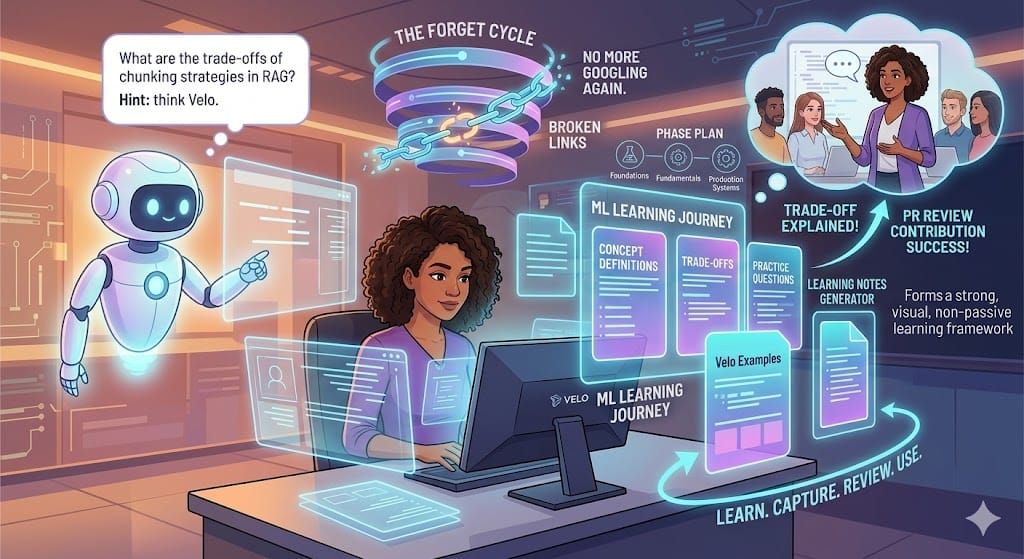
Every conversation with Claude was genuinely useful. I'd walk away understanding embeddings, or chunking strategies, or why RAG sometimes fails. But understanding something in the moment isn't the same as owning it.
The real tell was during PR reviews. A teammate would make a design decision around something that I had learned before. I'd have this vague sense of "I know this", but couldn't actually say anything useful. This inability to contribute to the conversation made me feel uncomfortable. And I think this feeling can be pretty common for anyone who is self-studying AI while actually building with it at the same time.
I didn't need more information. I needed a system to help retain what I had already learned.
Starting With Structure
I came across Shaw Talebi's ai-tutor skill, , a Claude Code skill that teaches AI/ML concepts in plain English, using narrative and intuition instead of jargon. This alone made learning feel more like a conversation and less like reading documentation.
Using this as a base, I asked Claude to help me design a learning plan built around what I was actually working on in Velo:
- Phase 1 (8 weeks): LLM Foundations: prompt engineering, RAG, agentic workflows
- Phase 2 (8 weeks): ML Fundamentals: neural networks, transformers, evaluation
- Phase 3 (8 weeks): Production Systems: observability, optimization, system design
This provided me with a good structural plan. The next step was to take this syllabus off the shelf to do some actual learning.
Turning Claude Into a Tutor
Turning Claude Into a Tutor
Claude Code has a skills system. You can define custom behaviors in simple instruction files that Claude will use automatically, so I built a skill called "ML Learning Journey" to make Claude:
- Guide you step by step instead of jumping around
- Use Socratic questioning to asks you things instead of just explaining
- Connect every concept back to your actual project
- Check your understanding before moving on
A typical module would start with the problem a concept solves, walk through a real example from Velo, help me build something small, then ask: "When would you choose RAG over fine-tuning? How would you debug
poor retrieval?"
It felt less like reading and more like having a patient mentor who wouldn't let me move on until I actually got it.
The Retention Problem (Still Not Solved)
Better learning sessions helped. But a few days after a good session, I'd start losing the details. Not the concept itself, I'd still understand it in the abstract, but I became less sure of the specifics – the examples, the tradeoffs, the things that are useful in a conversation or a code review.
So I built a second skill: "Learning Notes Generator".
After each session, this skill would generate structured markdown notes:
- Concept definitions in plain English
- Example that made it click
- Tradeoffs
- Practice questions
And everything was saved locally in a consistent format. The loop became:
Learn. Capture. Review. Use.
The "use" part matters. I can upload my own notes back to Claude and get quizzed on them. This is not a passive review, but an active recall using the exact examples and framing that will help me retain what I've learned.
The Moment It Actually Worked
A teammate pushed a PR with a retrieval design decision I would have scrolled past six months ago.
This time, I had something to say. Not because I'd just read about it, but because I remembered a specific example from a session weeks earlier. I could explain the tradeoff, ask a useful question, and point to why one
approach would hurt us at scale.
That's the thing about learning by example – the example is what you remember. The concept just comes with it.
One Thing I Didn't Expect
Building the system taught me as much as using it.
Designing how to learn something forces you to think about what good explanations look like, what actually makes things stick, and how to structure information so future-you will remember it. I had to understand
the concepts well enough to decide how to teach them. In a way, I learned AI by building the thing that would teach me AI.
Try It Yourself
The setup takes about five minutes:
# 1. Install the ai-tutor dependency
mkdir -p .claude/skills/ai-tutor
curl -o .claude/skills/ai-tutor/SKILL.md \
https://raw.githubusercontent.com/ShawhinT/ai-tutor-skill/main/SKILL.md
# 2. Install the learning skills
git clone https://github.com/TanimaRanjan/ai-learning-skills.git /tmp/ai-learning-skills
mkdir -p .claude/skills/ml-learning-journey
mkdir -p .claude/skills/learning-notes-generator
cp /tmp/ai-learning-skills/ml-learning-journey/SKILL.md \
.claude/skills/ml-learning-journey/
cp /tmp/ai-learning-skills/learning-notes-generator/SKILL.md \
.claude/skills/learning-notes-generator/
# 3. Create folders for your notes
mkdir -p concepts sessions exercises decisions quick-reference
Then start a session: "Teach me about RAG architecture" and build from there.
Repo: GitHub - TanimaRanjan/ai-learning-skills: AI Learning Skills for Claude
This started as "I need to learn ML" and turned into something I didn't expect – a system that actually compounds. Every session adds to a knowledge base I can come back to, search, and share.
If you're learning AI while building with it, try structuring it. You don't need anything fancy. Just AI, a folder, and some consistency.
If you've built something similar or have a different approach, I'd love to hear it.